- Monday Momentum
- Posts
- OpenAI's $110 Billion Bet
OpenAI's $110 Billion Bet
Why OpenAI needs to spend $665 billion before making a dollar of profit and what that means for every company building on their platform

Justin Wright
March 09, 2026 • Est. Reading Time: 5 minutes
Happy Monday!
OpenAI just closed $110 billion in funding (yes, billion with a ‘B’). Amazon put in $50 billion, Nvidia and SoftBank each committed $30 billion, and OpenAI's pre-money valuation hit $730 billion. It's the largest private fundraise in history, for a company that lost $9 billion last year and projects $14 billion in losses for 2026.
That disconnect between valuation and profitability isn't a red flag investors missed, it's the bet itself. OpenAI is wagering that whoever spends the most on compute infrastructure in the next four years wins the AI platform war, and everyone else becomes a footnote. The numbers they're projecting to get there are staggering.
The question for practitioners isn't whether OpenAI can raise the money. They’ve already proven they can. The real question is what happens to every company building on their platform if the economics don't work.
OpenAI raised $110 billion at a $730 billion valuation, projecting $665 billion in cumulative cash burn through 2030 before turning profitable. They spend $1.69 for every dollar of revenue. Microsoft sat out but retains Azure exclusivity. Amazon bought in but its API calls still route through Azure. For practitioners, this signals either the most ambitious infrastructure play in tech history or the most expensive assumption that hasn't been tested.
The Numbers That Should Make You Uncomfortable
OpenAI tripled revenue to $13.1 billion in 2025 and is projecting $30 billion for 2026. Those are real numbers, the problem is what's happening on the other side of the ledger.
The company expects to burn $25 billion in cash this year. Training costs alone hit $32 billion in 2026, climbing to $65 billion in 2027. The cumulative cash burn through 2030 is projected at $665 billion. OpenAI itself told investors it will burn through $665 billion before the business sustains itself.
Adjusted gross margins dropped to 33% instead of the targeted 46% because inference costs quadrupled in 2025. When your users cost more than expected to serve and your training costs are accelerating, the path to profitability gets steeper, not flatter.
OpenAI doesn't plan to become cash-flow positive until 2030, when it projects $39 billion in positive cash flow against $280 billion in revenue. HSBC's analysts are less optimistic: they concluded OpenAI likely won't make money by 2030 and still faces a $207 billion funding shortfall to power its own growth plans. Bloomberg projects the company needs $125 billion in annual revenue just to break even by 2029.
For context, Anthropic is targeting break-even by 2028 with cash burn dropping to 9% of revenue by 2027. The efficiency gap between the two approaches is widening, not closing.
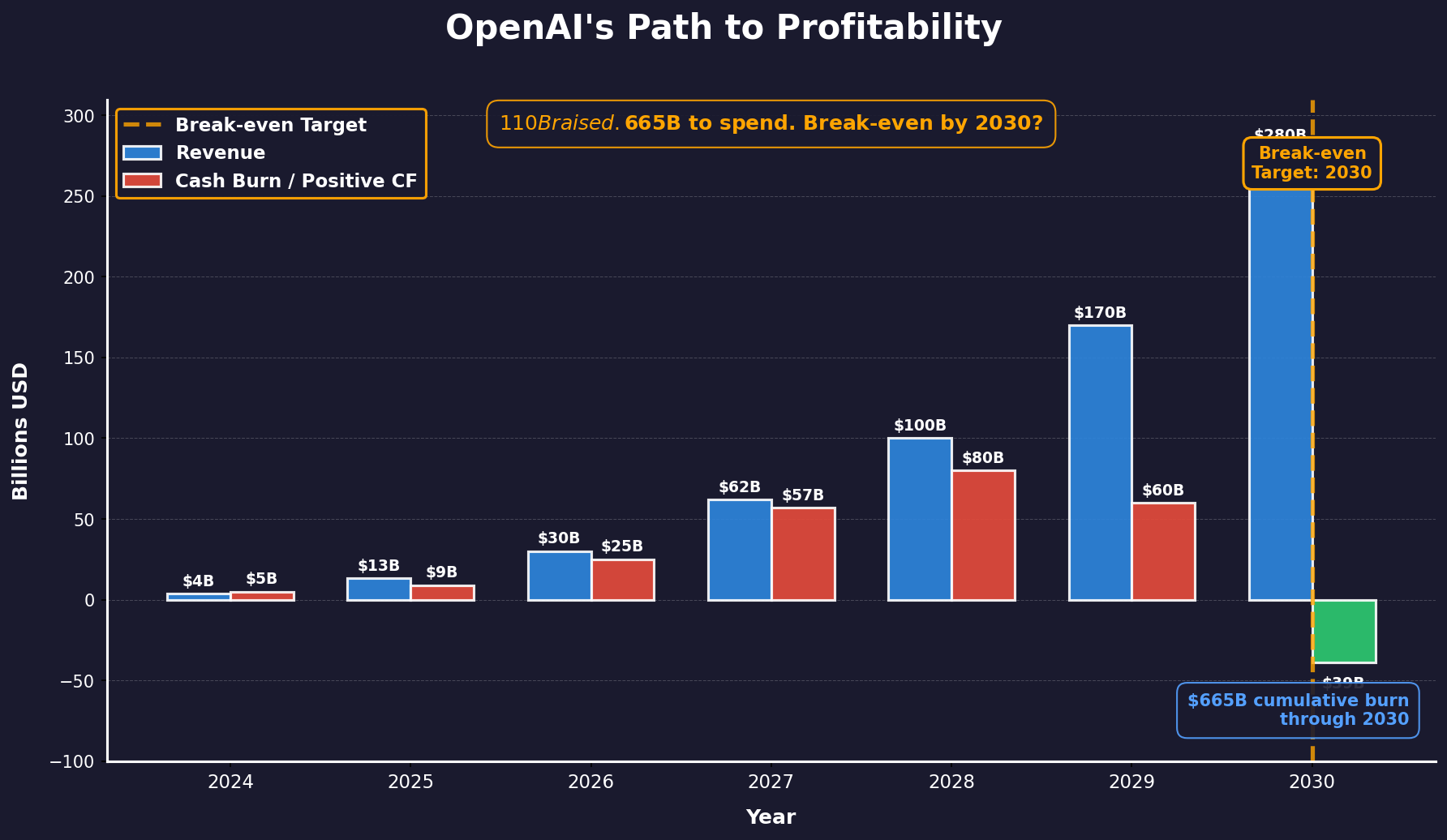
OpenAI's financial trajectory: $665 billion in cumulative cash burn through 2030, with profitability projected no earlier than 2030.
The Microsoft Question Nobody Wants to Ask
Microsoft didn't participate in this round. After investing over $13 billion across multiple rounds, the company that built its entire AI strategy around OpenAI watched from the sidelines while Amazon, Nvidia, and SoftBank wrote the checks.
Both companies issued a joint statement insisting nothing has changed. Azure remains the exclusive cloud provider for OpenAI's stateless APIs. Microsoft retains exclusive IP licensing across all OpenAI models. All API calls, even from Amazon's integration, route through Azure. Microsoft's existing stake is valued at roughly $135 billion, representing about 27% of the company on a diluted basis.
On paper, Microsoft's position is enviable. They get the financial upside without additional capital outlay, but the subtext is harder to ignore. Microsoft has started offering Claude within Office 365, signaling to investors it isn't trapped by OpenAI. OpenAI is selling ChatGPT Enterprise directly to the same companies Microsoft targets with Copilot, making them competitors. And OpenAI's deal with Oracle means Azure is no longer the only cloud infrastructure in the picture.
The relationship is shifting from partnership to strategic hedging on both sides. Microsoft benefits most if OpenAI succeeds, but is quietly building escape routes in case it doesn't.
The Circular Economics Problem
Here's where it gets uncomfortable for anyone building on this stack. Amazon invests $50 billion in OpenAI, then OpenAI commits $100 billion in expanded AWS spending over eight years. Nvidia invests $30 billion, then OpenAI commits to 5 gigawatts of compute capacity on Nvidia's Vera Rubin systems. The money flows in a circle: investors fund OpenAI, OpenAI spends the money buying those investors' products, the investors' revenue grows, their stock prices rise, and they invest more.
This pattern works as long as end-user revenue eventually catches up. OpenAI needs its $280 billion revenue target by 2030 to make the math work. If revenue growth stalls, or if inference costs don't decline fast enough, the circular funding model starts looking less like a flywheel and more like a dependency loop.
The $600 billion compute spending target OpenAI shared with investors through 2030 assumes that scale continues to unlock capability. That's been true historically, but the post-training revolution we covered previously suggests capability gains are increasingly coming from optimization, not raw compute. If smaller, more efficient models close the gap, OpenAI's infrastructure-first strategy becomes a liability rather than a moat.
What This Means If You're Building on OpenAI
The $110 billion gives OpenAI roughly four years of runway at current burn rates. That's not infinite funding, it's only a window. The business model requires everything to go right: revenue hits $280 billion, inference costs come down, training efficiency improves, and competitors don't undercut pricing with more efficient architectures.
For practitioners, this creates a specific kind of risk. You're building on a platform whose economics haven't been proven at scale. OpenAI's API pricing has already changed multiple times, and the pressure to reach profitability will intensify every year between now and 2030. If pricing increases or model availability shifts to favor higher-margin enterprise deals, startups and smaller teams will get squeezed first.
The strategic play is hedging. Build abstractions that let you swap providers. Test workloads across OpenAI, Anthropic, and open-source alternatives. The companies that survive platform transitions are the ones that aren't locked in when the economics shift.
The Bottom Line
OpenAI's $110 billion round is simultaneously the strongest signal of confidence in AI's future and the most explicit admission that the current economics don't work. The company projects spending $665 billion before turning a profit. That's a bet on a future where AI revenue scales faster than any technology in history.
And the craziest part is that bet might pay off. OpenAI has 900 million weekly users, the strongest distribution in AI, and enough capital to outlast almost any competitor. But the margin for error is razor-thin when you're spending $1.69 for every dollar you earn, and the plan requires near-perfect execution for four consecutive years.
For everyone building in this space, the lesson is straightforward: the platform you build on today may not have the same pricing, availability, or even the same business model in 2028. Plan accordingly.
In motion,
Justin Wright
If the largest private fundraise in history is funding a company that won't be profitable for four more years, what does that tell us about how the market prices AI's potential versus its current reality, and what happens if reality takes longer than the runway?

OpenAI raises $110B in one of the largest private funding rounds in history - TechCrunch
OpenAI says it plans to report stunning annual losses through 2028 - Fortune
OpenAI Boosts Revenue Forecasts, Predicts $111 Billion More Cash Burn Through 2030 - The Information
Microsoft and OpenAI joint statement on continuing partnership - Microsoft Blog
OpenAI secures $110B funding round with Amazon, Nvidia, SoftBank - Axios
HSBC Analysis: OpenAI unlikely to reach profitability by 2030 - R&D World

If you haven’t listened to my podcast Mostly Humans: An AI and business podcast for everyone yet, new episodes drop every week!
Episodes can be found below - please like, subscribe, and comment!