- Monday Momentum
- Posts
- When AI Becomes the Excuse
When AI Becomes the Excuse
What Oracle's 30,000 job cuts, Block's 40% staff reduction, and a Bloomberg survey reveal about the gap between AI hype and actual displacement

Justin Wright
March 16, 2026 • Est. Reading Time: 5 minutes
Happy Monday!
Jack Dorsey wore a hat that said "LOVE" on the video call where he told 4,000 Block employees they no longer had jobs. His explanation: AI tools now enable smaller, more efficient teams. "I think most companies are late," he wrote. "Within the next year, I believe the majority of companies will reach the same conclusion."
The same week, Bloomberg reported that Oracle is planning to cut 20,000 to 30,000 employees to free up $8 to $10 billion for AI data center infrastructure. And a Resume.org survey of 1,000 hiring managers landed with a finding that should reframe the entire conversation: 59% of companies say they blame AI for layoffs or hiring freezes "because it plays better" with stakeholders than admitting the real reasons are financial constraints.
So which is it? Is AI actually replacing workers at scale, or has it become a convenient corporate excuse?
The answer, frustratingly, is both.
Oracle is cutting up to 30,000 jobs to fund AI infrastructure. Block eliminated 40% of its workforce, blaming AI. But a Bloomberg-covered survey found 59% of companies cite AI in layoffs because "it plays better" than financial constraints. Stanford research shows the real displacement is concentrated among entry-level workers. The truth is messier than either narrative.
The Cuts Are Real, But the Reasons Are Complicated
Block's numbers are staggering on their surface: 4,000 people, 40% of the company, gone in a single announcement. Dorsey framed it as visionary, a company getting ahead of an inevitable shift. Investors agreed, and Block's stock jumped 24% in after-hours trading.
But the context tells a different story. Block more than tripled its headcount between 2019 and 2022, ballooning from 3,835 to 12,430 employees. A Financial Technology Partners analyst told Bloomberg the cuts are "more about the business being bloated for so long than it is about AI." Six months before the layoffs, Block spent over $60 million on a three-day anniversary celebration. When an employee raised morale concerns at a staff meeting, describing it as "the worst I've felt in four years," the response was more AI mandates.
Oracle's situation is structurally different but equally revealing. The company isn't cutting jobs because AI replaced those workers. It's cutting jobs to fund AI infrastructure for other companies. Oracle's capital expenditure guidance for fiscal year 2026 hit $50 billion, up from $21.2 billion in 2025 and $6.9 billion in 2024. That includes commitments from a $156 billion OpenAI deal requiring 3 million GPUs over five years. US banks have retreated from financing the buildout, doubling Oracle's borrowing costs. The layoffs aren't just about AI making employees redundant, they're actually about finding cash to build data centers.
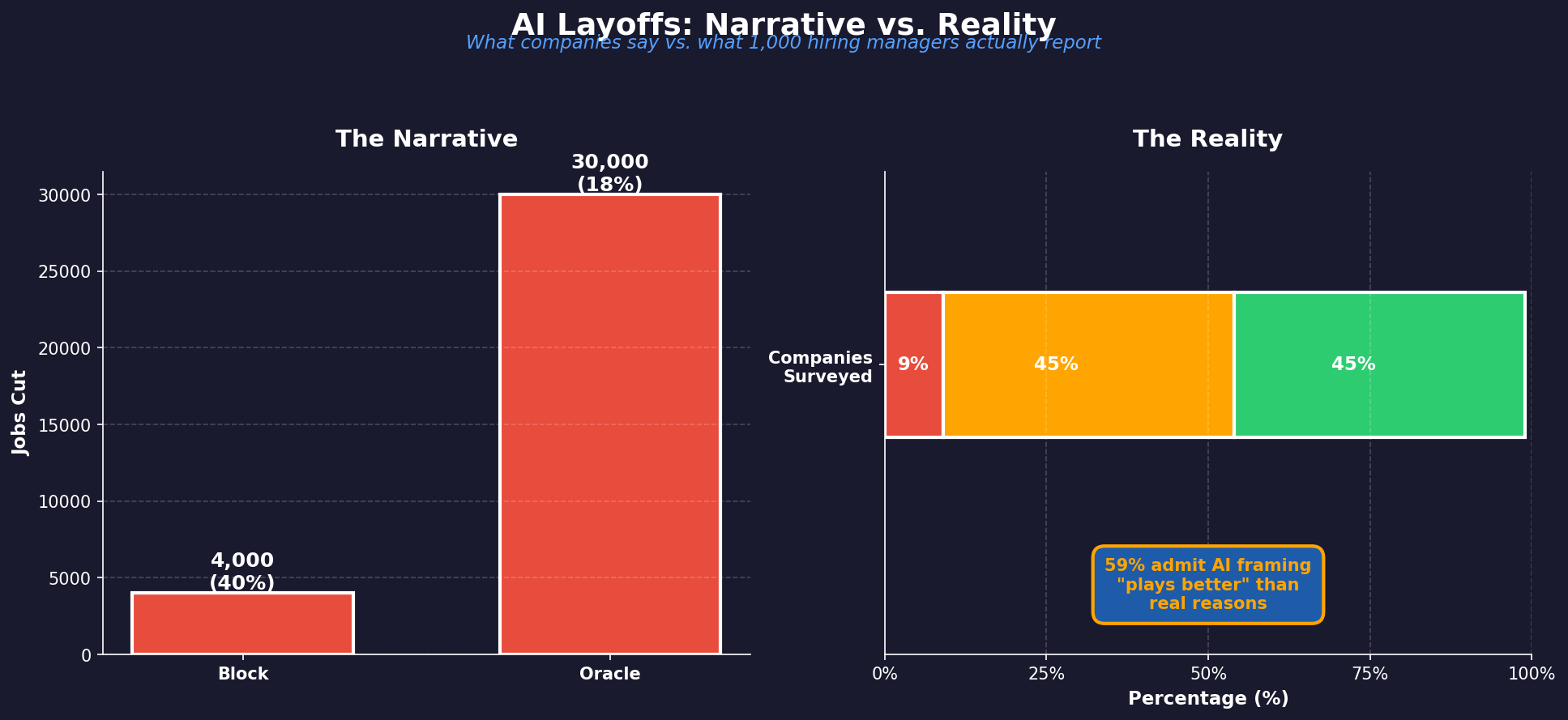
The AI layoff landscape: corporate narratives vs. underlying drivers at Block (workforce bloat) and Oracle (infrastructure financing).
The 59% Problem
The Resume.org survey is the most important data point in this story. When 59% of hiring managers admit they frame layoffs as AI-driven "because it plays better," that's not a minor finding. It means the majority of AI layoff headlines you've read in the past year may be, at best, exaggerated.
Only 9% of companies report that AI has fully replaced certain roles. Another 45% say it has partially reduced the need for new hires, and 45% report little to no impact on staffing levels. The phenomenon has earned a name: "AI-washing," where companies use artificial intelligence as cover for restructuring, over-hiring corrections, and budget constraints.
As Resume.org's Head of Career Advising, Kara Dennison, put it: "AI has become an explanation because it sounds strategic and forward-looking. When AI is used as a blanket explanation and workloads do not meaningfully change, trust erodes quickly."
Goldman Sachs economists estimate AI is currently eliminating only 5,000 to 10,000 jobs per month across all U.S. sectors. In a labor market of 160 million workers, that's a rounding error. The narrative has outpaced the reality by a wide margin.
Where AI Is Actually Displacing Workers
Stanford's Digital Economy Lab published research showing that AI displacement, while smaller than the headlines suggest, is real and concentrated in specific places.
Entry-level software developer employment for workers aged 22 to 25 has declined nearly 20% since late 2022. Call center hiring is down 15%. The pattern is consistent across accounting, administrative support, and customer service. In every case, the displacement hits the youngest workers hardest while experienced employees remain stable or see growth.
The mechanism is straightforward. AI excels at replacing codified knowledge: the syntax, algorithms, and procedures taught in degree programs. Companies are using AI for that baseline work and keeping experienced workers for the complex, ambiguous problems AI can't handle. Entry-level roles that once served as training grounds are disappearing, and nobody is building replacements.
Erik Brynjolfsson, the Stanford economist who led the research, flagged the long-term risk: industries will struggle to develop the next generation of experienced talent if the entry-level pipeline dries up. Unlike previous technology shifts that created new categories of starter jobs, generative AI appears to be eroding the bottom rungs of the career ladder without replacing them.
What Practitioners Should Actually Worry About
The AI layoff narrative is noisy. Most of it is corporate theater, but the signal underneath matters.
If you're early in your career, the Stanford data is real. The path from junior developer to senior engineer now has fewer on-ramps. Building projects, contributing to open source, and developing the tacit knowledge that AI can't replicate becomes more important, not less, when companies are hiring fewer entry-level positions.
If you're leading a team, adopting AI tools is now an inevitability. Whether you're using AI to genuinely augment your team's capabilities or whether you're participating in the same AI-washing the survey exposed becomes the deeper question. The companies that cut headcount and rebrand it as "AI transformation" without changing workloads will face the trust erosion Dennison described, and the talent market will notice.
If you're building products, the skills employers actually want are telling. Problem-solving ranked first at 54%. Learning new tools quickly came second at 44%. AI familiarity ranked fourth at 31%. The market values adaptability over any specific tool, including AI itself.
The Bottom Line
The gap between AI layoff narratives and AI layoff reality is wider than most people realize. Oracle is cutting 30,000 jobs to build data centers, not because AI replaced those workers. Block is correcting a hiring binge from 2019-2022 and calling it an AI strategy, and 59% of companies admit the AI framing is performative.
But the displacement that is happening, concentrated among entry-level workers in high-exposure fields, is genuine and accelerating. The career ladder is losing its bottom rungs. That's the story worth paying attention to, not because it fits a clean narrative about AI eating jobs, but because it demands a more thoughtful response than either panic or dismissal.
In motion,
Justin Wright
If 59% of companies are using AI as an excuse for layoffs that have nothing to do with AI, how long before the labor market stops believing the companies where AI actually is the reason?

Jack Dorsey's 4,000 Job Cuts at Block Arouse Suspicions of AI-Washing - Bloomberg
Oracle Plans Major Layoffs of 20,000-30,000 Staff to Offset AI Data Center Costs - MLQ
59% of hiring managers stress AI's role in layoffs "because it plays better" - Bloomberg/Techmeme
Is Block's Decision a Bellwether? - Josh Bersin

If you haven’t listened to my podcast Mostly Humans: An AI and business podcast for everyone yet, new episodes drop every week!
Episodes can be found below - please like, subscribe, and comment!